Summary
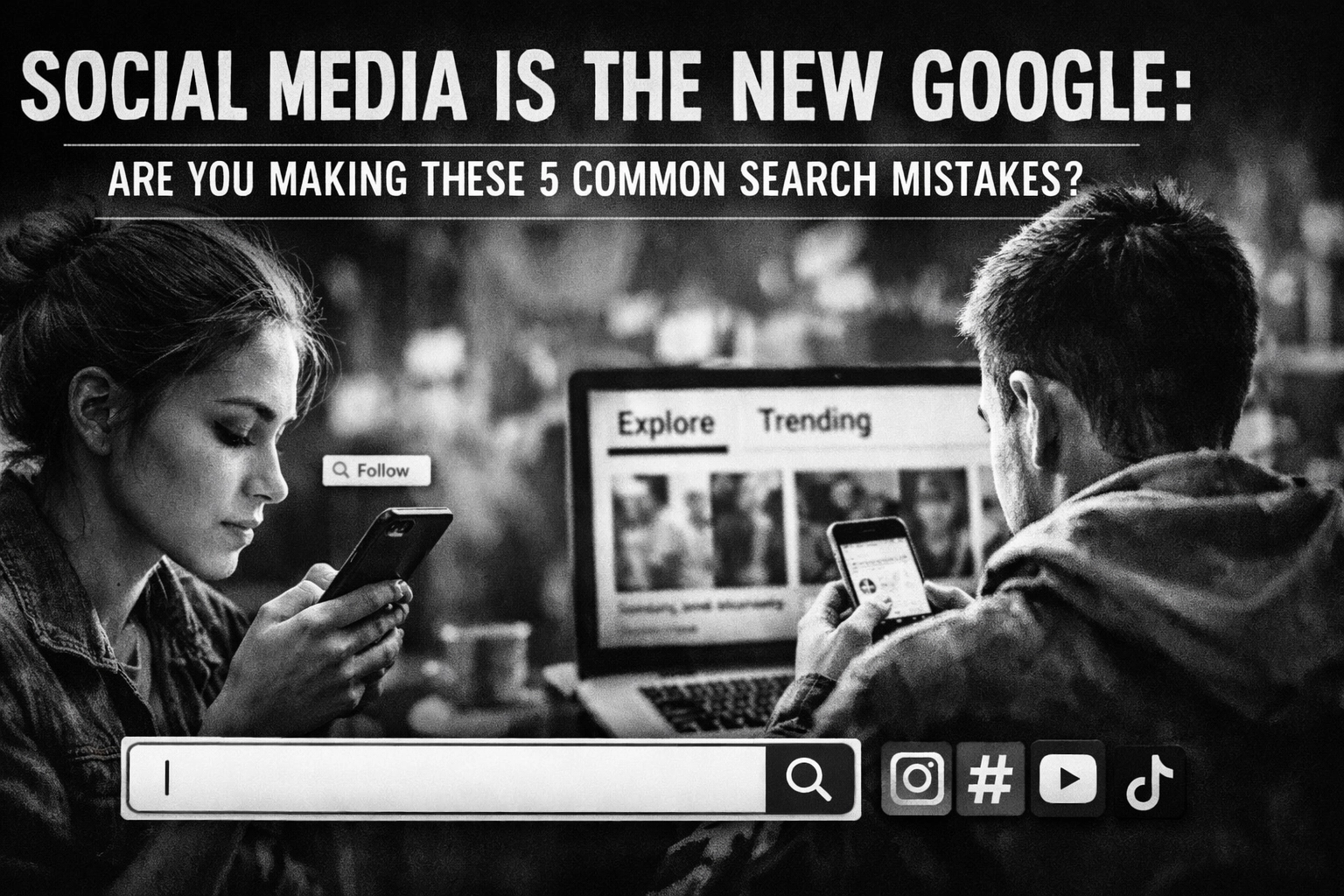
Social media has evolved beyond just likes and shares: it's now where your audience makes buying decisions before they ever touch Google. If you're still treating TikTok, Instagram, and YouTube as "nice-to-have" channels while pouring everything into traditional SEO, you're missing where the real discovery happens. This post breaks down the five critical mistakes brands make when they fail to recognize that social platforms are the new search engines: and how to fix them before your competitors do.
Let's get real for a second: when was the last time you Googled a restaurant without checking Instagram first? Or bought something online without scrolling through TikTok reviews?
Exactly.
Welcome to 2026, where "just Google it" has quietly become "let me check TikTok" or "I saw someone talk about this on YouTube." The shift is not coming: it's already here. And if your brand strategy hasn't caught up, you're basically invisible to the people who matter most: your future customers.
The truth is, social media is no longer just a megaphone for your brand. It's the research lab where people decide what they think about you long before they type your name into a search bar. And most businesses? They're fumbling the ball in ways they don't even realize.
Here are the five most common (and most expensive) mistakes you're probably making right now.

Mistake #1: You Are Still Optimizing Only for Google
If your entire digital strategy revolves around ranking on Google, congratulations: you're fighting yesterday's war.
Don't get me wrong. Google still matters. But by the time someone searches for your brand name on Google, the decision has usually already been made. They saw you on TikTok. Their friend tagged them in your Instagram Reel. They watched a YouTube video comparing you to your competitor. Google is just the confirmation step.
The new customer journey starts on social platforms. That's where curiosity gets sparked, where trust gets built, and where preferences get locked in. If you're not showing up in those spaces with content that answers real questions and builds real connection, you're arriving to the party after everyone's already gone home.
Think about your own behavior. When you want to know if a product actually works, do you read the brand's website? Or do you scroll through Reddit threads and TikTok comments from real people who have zero incentive to lie to you?
Your customers are doing the same thing. And if your brand isn't part of that conversation, someone else's is.
Mistake #2: You Treat Social Proof Like a Nice Bonus Instead of the Main Event
Traditional SEO taught us to obsess over backlinks, domain authority, and keyword density. Social search? It runs on a completely different fuel: belief.
When people search on social platforms, they're not just looking for information. They're looking for validation. They want to see that other people: real people, not bots or brand cheerleaders: trust you, use you, and recommend you.
This is why a founder sharing behind-the-scenes content on LinkedIn often converts better than a polished ad campaign. It's why user-generated content outperforms studio-quality product shots. It's why a 30-second testimonial video on Instagram Stories can do more for your credibility than a five-page case study buried on your website.
Social proof is not a supporting character anymore. It's the lead actor.
If your content strategy doesn't prioritize showing real people engaging with your brand: customers, employees, partners, even you as the founder: you're missing the entire point of why social search works in the first place.

Mistake #3: You Are Obsessed with Vanity Metrics
Let's talk about the lies we tell ourselves.
"We got 10,000 likes on that post!"
Cool. How many of those people bought something? Called you? Booked a consultation? Told a friend about you?
Follower counts and likes are the fool's gold of social media. They feel good. They look impressive in a pitch deck. But they don't pay the bills.
What actually matters? Saves. Shares. Comments. Direct messages. These are the actions that signal real engagement, real interest, and real intent. When someone saves your post, they're saying "I want to come back to this." When they share it, they're putting their own reputation on the line to endorse you. When they comment or DM, they're starting a conversation.
Those are the metrics that lead to conversions. Not the double-tap from someone mindlessly scrolling at 2 AM.
If you're optimizing for reach instead of resonance, you're building a house on sand. The algorithm will change. The platform will shift. But genuine connection? That's what sticks.
At Gurupresario, we've worked with everyone from attorneys to dentists to executives, and the pattern is always the same: the brands that focus on meaningful engagement always outlast the ones chasing viral vanity.
Mistake #4: You Let Your Best Content Die After One Use
Here's a scenario that plays out every single day:
You work with a PR team. They land you a killer feature in a major publication. You post the link once on LinkedIn. Maybe you add it to your website's press page. And then... nothing.
That story: packed with data, quotes, and authority: just sits there, collecting digital dust.
Meanwhile, your audience is on TikTok asking questions that story could answer. They're on YouTube looking for explainers. They're on Instagram searching for quick, visual breakdowns of exactly the kind of expertise you just showcased.
Earned media is not the finish line. It's the starting material.
Every press feature, every interview, every piece of authority content you create should be repurposed into multiple formats across multiple platforms. Turn that article into a carousel post. Break it into short-form videos. Record a podcast episode diving deeper. Create quote graphics. Film a "behind the story" TikTok.
The goal is not just to get coverage. The goal is to make sure that coverage lives everywhere your audience is searching: because they're not all reading the same publications you're pitching.
Mistake #5: Your PR Team and Social Team Are Not Talking to Each Other
This one drives us crazy.
Your PR team is chasing backlinks and media mentions. Your social team is chasing engagement and followers. And neither team has any idea what the other is doing.
The result? Wasted effort, mixed messages, and campaigns that fizzle out because they're not built to travel across the entire search ecosystem.
In 2026, you cannot afford to treat digital PR and social strategy as separate lanes. They need to be designed together, from the jump. Your PR pitch should be informed by what people are actually searching for on TikTok and YouTube. Your social content should amplify and extend the authority you're building through earned media.
When these strategies work together, you create a compounding effect. The press mention drives social curiosity. The social content drives more search volume. The search volume validates more press opportunities. It's a cycle that feeds itself: but only if your teams are rowing in the same direction.
We have seen this transformation firsthand at Gurupresario. When brands stop thinking in silos and start thinking in stories that travel across platforms, everything changes. Suddenly, you are not just getting mentions: you are owning the conversation.
The Bottom Line: Stop Searching, Start Being Found
The brands winning in 2026 are not the ones with the biggest ad budgets or the fanciest websites. They are the ones showing up authentically, consistently, and strategically in the places where their audience is actually looking.
Social media is not a side hustle for your marketing team anymore. It's the front door. It's the first impression. It's where trust gets built and decisions get made.
If you are still treating it like a broadcast channel: pushing out content without listening, engaging, or optimizing for discovery: you are leaving money on the table. Lots of it.
But here is the good news: it is not too late to fix this. You just need a strategy that treats social search as seriously as you have treated Google for the past decade. You need to think about your content as answers, not ads. You need to build for engagement, not vanity. And you need to tell stories that travel.
That is where we come in.
Ready to stop guessing and start growing? Let's build a strategy that actually meets your audience where they are: on social, in search, and everywhere in between. Book a complimentary one-on-one session with a media marketing expert at https://calendly.com/mausanchez/meet or give us a call at (512) 988-5194. Let's make your brand impossible to ignore.


