Summary
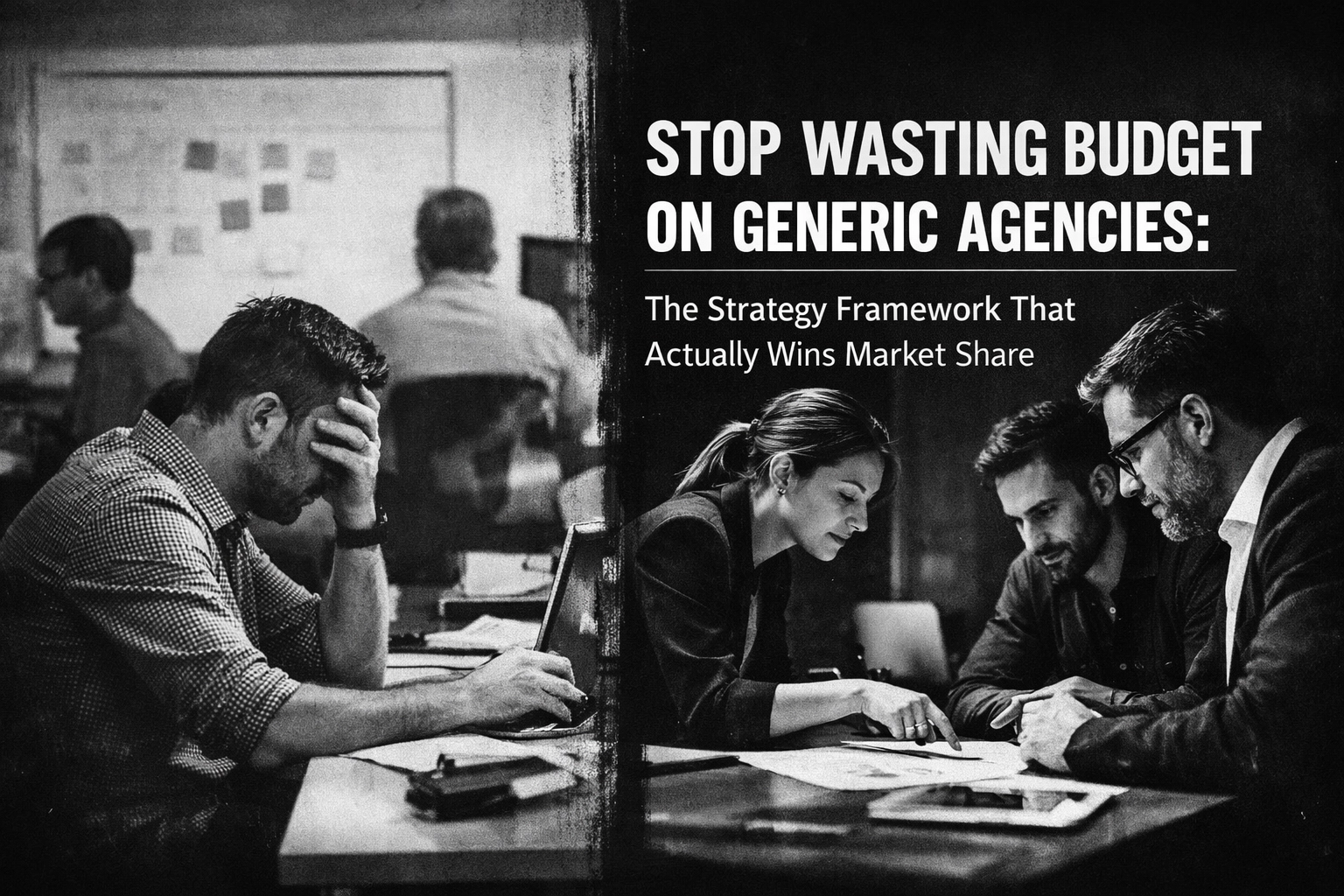
Most businesses burn through marketing budgets working with generic agencies that promise the moon but deliver cookie-cutter campaigns. The problem is not the effort: it is the strategy. Generic approaches spread your resources too thin, targeting everyone and connecting with no one. This post breaks down the STP framework (Segmentation, Targeting, Positioning) that successful brands use to stop wasting money and start winning actual market share. We will show you how precision beats volume every single time, and why your brand story matters more than ever in 2026.
The Generic Agency Trap
You have seen it a dozen times. An agency promises to "elevate your brand" and "drive engagement across all channels." They create a beautiful deck, throw around buzzwords like "synergy" and "omnichannel," and six months later, you are left wondering why your revenue has not budged.
Here is the brutal truth: generic agencies treat every client like a template. They run the same playbook for a law firm, a dental practice, and a tech startup. Same social media calendar. Same "viral content" strategy. Same vague promises about reach and impressions.
But reach means nothing if you are reaching the wrong people. Impressions mean nothing if nobody remembers you five seconds later.
The real issue is not that these agencies lack talent: it is that they lack strategy. They are shouting into the void and hoping someone, anyone, will listen. That is not marketing. That is just noise.

The Framework That Actually Works
Smart brands in 2026 are not casting wide nets. They are fishing with spears.
Enter the STP framework: Segmentation, Targeting, Positioning. It sounds simple because it is. But simple does not mean easy, and it definitely does not mean generic.
Segmentation: Know Who You Are Talking To
Before you spend a single dollar on ads, content, or production, you need to slice your market into distinct groups. Not "everyone who might need our service": actual, specific segments based on real data.
Break your audience down by demographics (age, income, location), psychographics (values, lifestyle, pain points), behaviors (how they buy, what they consume), and geography. A solo attorney in Austin has different needs than a 50-lawyer firm in Manhattan. A cosmetic dentist targeting millennials needs a completely different approach than a pediatric dentist serving families.
This is where most agencies fail. They lump everyone together because it is easier to sell one campaign than five customized ones. But you are not paying for easy: you are paying for results.
Targeting: Pick Your Battles
Once you have your segments mapped out, you need to decide which ones are actually worth pursuing. Not every segment deserves your attention or your budget.
Ask three questions: Is this segment large enough and growing? Can we actually reach them effectively? Will they deliver strong ROI?
If the answer to any of those is no, move on. Focus your energy on the segments that align with your strengths and long-term goals. A fractured strategy serves no one: not you, not your team, and definitely not your bottom line.
This is where real strategy separates winners from losers. Winning market share is not about being everywhere. It is about being exactly where your ideal clients are looking.

Positioning: Craft a Message That Sticks
Now comes the fun part. You know who you are talking to. You know which battles to fight. Now you need to tell a story that resonates.
Generic messaging dies in the feed. "We provide excellent service" and "Your success is our priority" are white noise. Every competitor says the same thing.
Positioning means understanding your segment's specific pain points and crafting a value proposition that speaks directly to them. What keeps them up at night? What are they trying to achieve? How does your brand uniquely solve their problem in a way nobody else can?
This is where Gurupresario's expertise in storytelling becomes your secret weapon. We do not just help you say something: we help you say something worth remembering.
Why Brand Storytelling Beats Generic Campaigns
In 2026, your brand is not what you say it is. Your brand is the story people tell about you when you are not in the room.
Generic agencies treat branding like a logo and a color palette. Real branding is about building a narrative that makes people care. It is about showing up consistently, authentically, and strategically across every touchpoint: your website, your social media, your podcast, your video content.
That is why we push clients to think bigger than "just" a marketing campaign. We are talking about brand architecture. Who are you? What do you stand for? Why should anyone choose you over the 47 other options in their search results?

The businesses winning market share right now are the ones telling human stories in a world drowning in AI-generated slop. They are the founders showing up on camera. The attorneys breaking down complex topics on their podcasts. The dentists creating educational content that builds trust before the first appointment.
They are not relying on generic tactics. They are building media empires around their expertise.
The Media-First Approach to Market Share
Here is what we have learned working with attorneys, doctors, dentists, and executives: the brands that win are the ones that think like media companies.
You are not just a service provider anymore. You are a publisher. A broadcaster. A storyteller.
That means investing in the infrastructure that supports great content: professional video production, strategic podcast development, cohesive content calendars, and brand systems that scale without losing authenticity.
Generic agencies will sell you a one-off video or a batch of social posts. That is not a strategy. That is a band-aid.
A real media-first strategy looks like this: You launch a podcast that positions you as the authority in your space. You repurpose that content into short-form video for social. You build an email list that converts listeners into clients. You create a content ecosystem where every piece supports the others, compounding over time.
That is how you win market share in 2026. Not by outspending competitors on generic ads, but by out-storytelling them at every turn.
Measuring What Matters
The final piece of this framework is accountability. STP only works if you pair it with SMART objectives: Specific, Measurable, Achievable, Relevant, Time-bound.
Generic agencies love to talk about vanity metrics. "We got you 10,000 impressions!" Great. How many of those turned into consultations? How many became paying clients?

Every dollar you spend should tie back to a measurable outcome. Every campaign should have a clear hypothesis and a way to test it. Every quarter should show progress toward real business goals: not just engagement rates.
This is where market share analysis becomes critical. You need to understand your competitive landscape, identify gaps where you can differentiate, and track how your positioning is landing over time.
The brands that win are the ones that treat marketing like a science, not a guessing game.
Stop Guessing, Start Winning
If you have been throwing budget at generic agencies and wondering why nothing sticks, it is time for a new playbook.
The STP framework is not sexy. It is not a hack or a shortcut. But it works. It forces you to get clear on who you are serving, how you will reach them, and what story you will tell when you do.
And when you pair that strategic clarity with world-class media production and storytelling expertise, you do not just win market share: you build a brand that lasts.
Your competitors are still working with the generic guys, running the same tired playbooks. Meanwhile, you could be building something that actually moves the needle.
Ready to Stop Wasting Budget?
If you are tired of generic strategies that go nowhere, let us talk. We specialize in helping brands like yours build media ecosystems that drive real results: not just pretty reports.
Book a complimentary one-on-one session with a media marketing expert at https://calendly.com/mausanchez/meet or give us a call at (512) 988-5194. Let us show you what a real strategy looks like.


