
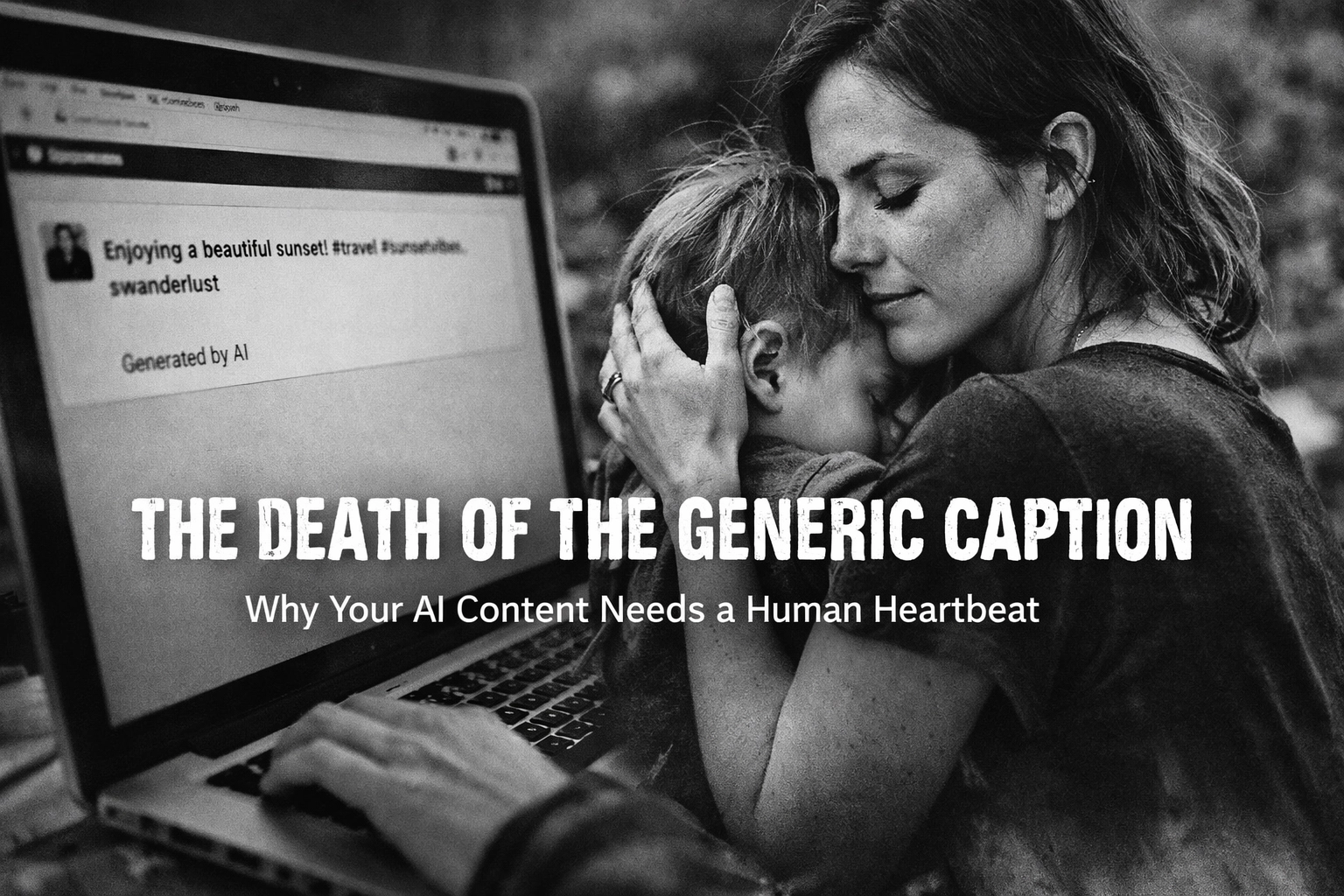
Summary: AI-generated content is everywhere in 2026, but the flood of generic captions is destroying brand differentiation. While AI offers speed and efficiency, it lacks the contextual understanding, emotional intelligence, and cultural nuance that makes content resonate. This post explores why the most successful brands are combining AI automation with human creativity to produce content that actually converts, and how you can do the same.
The AI Content Problem Nobody Wants to Talk About
We need to have an honest conversation about AI-generated content.
By February 2026, every brand and their cousin is using some form of AI to pump out captions, blog posts, and social media content. The tools are incredible. They are fast. They are affordable. And they are making everyone sound exactly the same.
Over 70% of marketers now cite bland, generic AI content as their top concern when using automation tools. That is not a small problem, that is a crisis of differentiation. When every real estate agent, dentist, attorney, and coffee shop is using the same AI prompt templates, the internet becomes a sea of sameness.
Your audience can tell. They scroll past it. They ignore it. And worse, they start ignoring your brand entirely.

Why AI Captions Miss the Mark
Let me break down what is actually happening behind the scenes when AI generates your content.
Context is everything. AI has none.
AI language models are pattern-matching machines. They predict the next most likely word based on billions of examples. But they do not understand your brand story. They cannot grasp the inside joke your audience loves. They miss the cultural reference that would make your caption click.
When AI transcribes a video or generates a caption, it achieves up to 98% accuracy by word error rate under ideal conditions. That sounds great until you realize that 2% error rate compounds across every piece of content you publish. More importantly, technical accuracy is not the same as meaningful communication.
Emotion does not compute.
Sarcasm. Wit. Irony. The perfect comedic pause. These are the elements that make content memorable, and AI fundamentally struggles to replicate them. It can identify that humor exists in training data, but it cannot create genuinely funny, timely, or emotionally resonant content from scratch.
This is especially critical for founder-led content and personal brands. When a CEO shares their perspective or an attorney discusses a recent case win, the audience connects with authenticity and personality, not robotic perfection.
Cultural nuance gets lost in translation.
AI models struggle with regional dialects, evolving slang, and local colloquialisms. They cannot adapt quickly to emerging trends or understand why a phrase that works in Austin might fall flat in New York. They miss the cultural context that makes content feel native to your specific audience.
For our clients in medical, legal, and executive spaces, this becomes even more problematic. Industry-specific terminology, compliance language, and professional tone require human oversight to ensure accuracy and appropriateness.

The Real Cost of Generic Content
Here is what happens when you lean too heavily on AI without human intervention:
Your brand becomes a commodity. When your captions sound like everyone else, why would a potential client choose you? Differentiation dies when personality disappears.
Trust erodes. Audiences are increasingly sophisticated. They can spot AI-generated content, and when they do, they question whether a real person is behind the brand. In industries like law, medicine, and executive coaching where trust is everything, this is brand suicide.
Engagement plummets. Generic content does not spark conversation. It does not get shared. It does not drive action. Your metrics suffer, your algorithm ranking drops, and you become invisible.
We have seen this pattern repeatedly with clients who come to us after trying the "AI-only" approach. Their content output went up. Their engagement went down. They were posting more and getting less.
The Human Heartbeat: What AI Cannot Replicate
At Gurupresario, we have spent years helping attorneys, doctors, dentists, and executives tell their brand stories through podcasting, video production, and content creation. Here is what we have learned: the magic is not in the tool. It is in the storytelling.
Humans provide context. A skilled content creator understands your brand history, your audience's pain points, and the specific message that will resonate at this exact moment. They know when to be serious and when to inject humor. They understand that the caption for a law firm's Instagram post requires a different tone than a DTC skincare brand.
Humans catch what AI misses. Background noise in video. A misheard word that changes meaning entirely. A culturally insensitive phrase. Accented speech that gets transcribed incorrectly. Human editors serve as the essential bridge between automated processes and quality control.
Humans create connection. The best content does not just inform, it makes people feel something. It tells a story. It builds relationship. This is not about rejecting AI; it is about understanding that AI is a tool, not a replacement for creative strategy.

The Hybrid Approach That Actually Works
The brands winning in 2026 are not choosing between AI and humans. They are leveraging both strategically.
Use AI for speed and structure. Let AI handle first drafts, transcriptions, and data analysis. Use it to identify trending topics and generate initial content frameworks.
Use humans for soul and strategy. Have real people refine messaging, inject brand personality, ensure cultural appropriateness, and make strategic decisions about tone and positioning.
Use systems for consistency. Build content workflows that combine automation with human checkpoints. Create brand voice guidelines that both AI tools and human creators follow.
This hybrid model is how we approach content at Gurupresario. When we produce podcast content for a client, we might use AI tools to generate initial transcriptions or suggest content topics. But every piece of final content is reviewed, refined, and infused with the unique perspective that makes that client's brand distinctive.
What This Means for Your Content Strategy Right Now
If you are currently using AI to generate captions and social content, here is your action plan:
Audit your recent content. Pull up your last 20 social posts. Do they sound like you? Could those exact captions work for your competitor? If yes, you have a differentiation problem.
Define your brand voice clearly. Create a document that captures not just what you say, but how you say it. Include examples of phrases you would use and phrases you would never use. This becomes the filter for all content: AI-generated or otherwise.
Build review checkpoints. Never publish AI-generated content without human review. Ever. Even if it is just a quick caption. The cost of one tone-deaf post far outweighs the time saved by skipping review.
Invest in storytelling. Think bigger than individual posts. How does your content ladder up to a larger brand narrative? How are you using video, podcasting, and long-form content to tell stories that AI simply cannot replicate?

The Content Landscape Has Changed
In 2026, content creation is easier than ever. Ironically, that makes standing out harder than ever.
AI is not going anywhere. The technology will only improve. But the brands that thrive will be the ones that understand AI is a productivity tool, not a personality replacement.
Your content needs to sound like a human wrote it because a human should have written it: even if AI helped along the way. Your audience is not looking for perfection. They are looking for connection. They want to know there is a real person behind the brand who understands their challenges and can guide them to solutions.
This is especially true in the professional services we work with most. When an attorney shares insights on a recent case or a doctor explains a new treatment approach, that content carries weight because of the human expertise behind it. AI can help structure that message, but it cannot replace the credibility and authenticity of human experience.
Your Next Move
The death of the generic caption is not about abandoning AI. It is about reclaiming your brand voice in an automated world.
It is about understanding that while AI can help you create more content, only human creativity and strategic thinking can help you create better content. Content that connects. Content that converts. Content that builds the kind of brand equity that actually drives business growth.
At Gurupresario, we have built our entire approach around this philosophy. We combine cutting-edge production tools with storytelling expertise to help our clients build brands that stand out. Whether through our podcast production services or comprehensive content strategies, we focus on the human elements that make brands memorable.
The question is not whether to use AI. The question is how to use it without losing the human heartbeat that makes your brand yours.
Ready to build a content strategy that actually sounds like you? Book a complimentary one-on-one session with our media marketing experts at https://calendly.com/mausanchez/meet or give us a call at (512) 988-5194. Let us help you tell your brand story in a way that cuts through the noise.


